

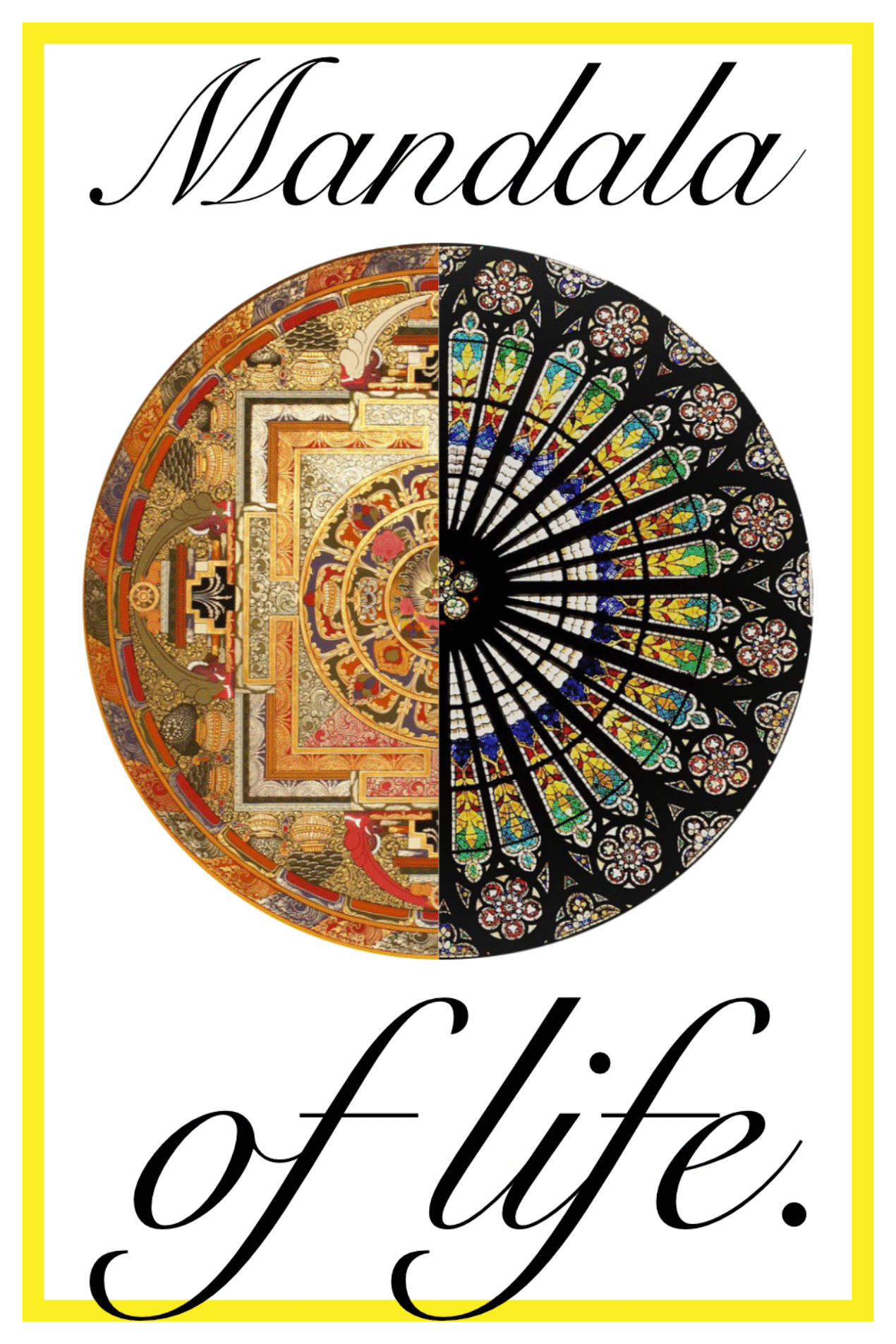
Mandala have been found all across cultures and thought out human history. We find them from East to West in so many different cultures: Dreamcatchers and Medicine Wheels of Native Americans, Aztec Calendars, Cathedral Rosettes in Europe, Buddhist Sand Mandalas… These patterns are more than just beautiful designs, they carry deep spiritual and cultural significance.
What is a mandala for?
Mandalas ask from you to be patient. Tibetan monks, for instance, spend hours creating their sand mandalas only to erase them once completed. This practice symbolizes that the process itself holds more value than the finished result. Just like in life, the journey is more important than the destination. But it also talks about impermanence, how nothing in this universe is “for ever”.
Mandalas are also an invitation to meditation. You can look at the intricate designs and quiet your mind. It allows you to find some inner peace and to know yourself a bit more.
Mandalas inspire a sense of beauty and with it, joy.
Mandalas also act as links to the divine (Yantra), offering a channel to receive cosmic truths. They are protective symbols believed to ward off negative energies and safeguard the soul.
At their core, mandalas are said to represent both the macrocosm (the vast, infinite universe with its intricate web of interconnected energies and forces) and the microcosm (the inner world of the individual). Each line and curve within a mandala is not merely a decorative element, but a symbolic representation of life’s balance, harmony, and complexity.
These geometric patterns mirror the natural world and the cosmic order, reflecting the intricate relationships between all things. In this way, mandalas serve as a visual reminder that our individual lives are part of a much larger, interconnected whole. Through their symmetrical designs, they invite us to explore the profound connection between our inner world and the vast universe around us.
The mandala of life.
As a representation of the universe, mandalas offer us a powerful lesson: interconnectedness. Each element within the mandala is connected to the others, forming a harmonious whole. No single shape stands alone – its beauty and purpose come from its place within the pattern.
And that is its wisdom: no one is important by themselves, but each of us is necessary. Just as a mandala would not exist without every individual line or curve; the world would not be complete without you.
So, the next time you feel unseen or insignificant, think of a mandala. You are not just part of the picture, you are essential to it. The mandala of life would be incomplete without your presence.