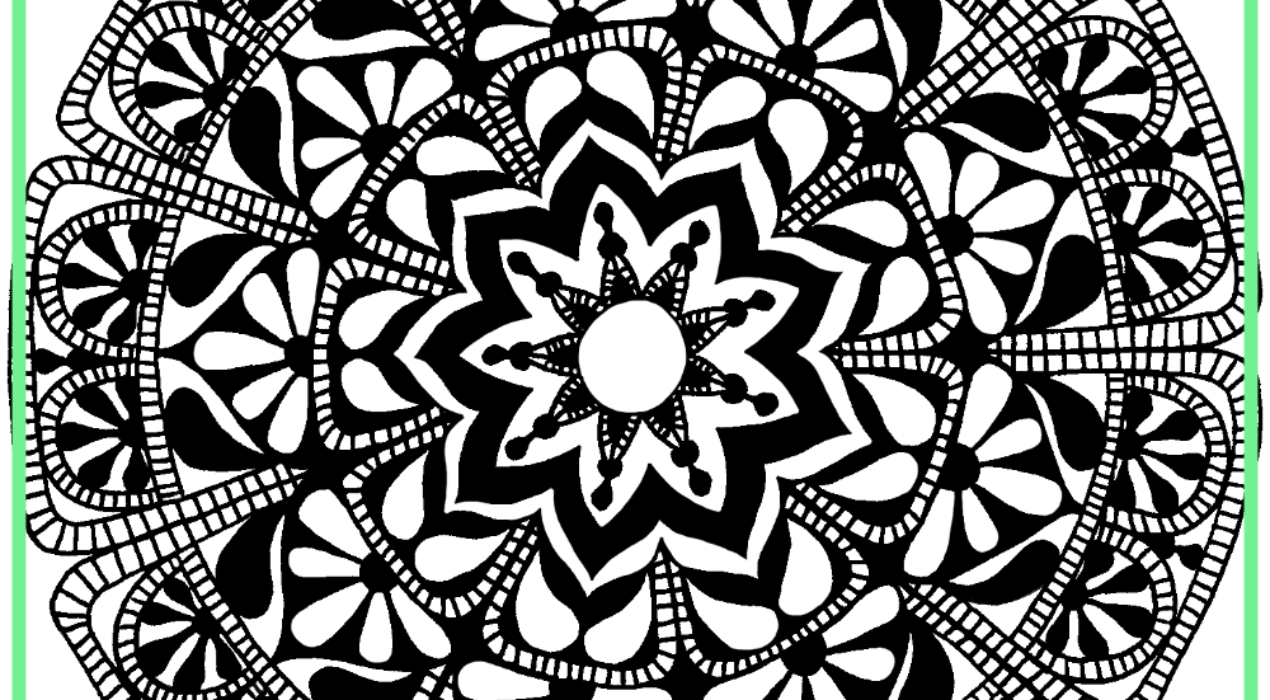
I’ve been drawing mandalas for a few years now, in front of my child. I have a young son (he is five now) so there isn’t much space to do things without him next to me. Hehe. He was curious to see what I was doing and once he tried to help me colour one but that’s it. This year, he asked me to draw a mandala together. He loves using the compass, the ruler and my other drawing tools. So we sat together with the tools and I let him start as I usually do, I didn’t give him to many instructions, I let him do what he wanted. I was curious to see what he had in mind. Once the grid was done. We started colouring and drawing shapes together. The result is so colourful and joyful. We’ve drawn a few mandalas together now. And I love it. For many reasons: I don’t take it as a time to analyse my son. It is just some time that we share doing something we like. The rest are extras. I think it is nice to start with nothing in mind and see how it unfolds. If you want to […]
Read More ›
Why do we need orienting? We live in societies that are too stressful for us (well, most of us). Too many noises, too many people, too many lights and things to do. Too much in general. And this creates constant stress in our bodies (and soul). Sadly, we don’t even know it until we’re older, and we start to have so many health issues. We don’t realise it because we’ve grown up in those cultures, it’s all we’ve ever known. Don’t get me wrong, some things in our society are wonderful. We’ve progressed so much. But our lifestyles are stressful. As living beings, we shouldn’t be “doing” all the time. We are meant to be in harmony with our environment. Not in this constant battle to change everything around us. One thing that happens with that constant hustle is that we lose awareness of what surrounds us. We laser focus on our task, and we forget the world around us, we tune out in a way. And I get it, sometimes it is necessary. But again, we are part of an ecosystem. We can’t thrive without that connection. So, what can we do about it? There is a simple technique […]
Read More ›
Colouring mandalas has gained traction in the last years. Why? Because it has many physical and mental benefits: -Relieves stress -Promotes mindfulness -Helps you sleep better. How, you may ask? Well, research says that you can’t stress about things in your life and focus on colouring in the lines at the same time. Those two activities require the activation of different parts in your brain and it can’t be done simultaneously. Thus, it creates a meditative state. So you can get the well-known benefits of meditation. Being in the present relaxes us, releases feel good hormones, that in turn helps regulate our nervous system etc. What I’d like to add to the conversation: The need we, humans, have to create and to use our hands. In a world that is so technological and where you can find everything ready made, we often forget to “do things”, to create. And this lack of creation brings us sadness and a feeling of uselessness. So, colouring a mandala (a real one, on paper) is relaxing but it also gives us the satisfaction of seeing the mandala coming, of seeing the end result. To know that we’ve done it. 🙂 There is also the […]
Read More ›
I’ve been thinking about sand mandalas and rangolis (there are many other names for those, that’s the name I learned while travelling in Karnataka)… Both are beautiful, ephemeral drawings made with coloured sand (and for rangolis, flowers too). What are Rangolis and Sand Mandalas? For those who don’t know, sand mandalas are a meditation practice of Tibetan Buddhism (that follows a strict ritual procedure); rangolis are drawings made on the threshold of homes or home shrines and they have many symbolic meanings, one being keeping the evil eye at bay and welcoming gods (and people) into the household. So, though the rituals and meanings change a little between the two, I see a connection. And there are many aspects of both that I find interesting: For me, it’s about the time-old philosophy that the journey is more important than the destination. It is a material way of sharing this knowledge. And it also teaches us the importance of doing whatever task we undertake with dignity and patience and love. Trying to be at our best for the pleasure of it, not because we will be socially rewarded. Rangolis are also done as a daily morning household ritual. It’s beautiful having […]
Read More ›
Haw can you draw a Mandala? Once you have your grid, the fun starts! But If you don’t know how to draw a grid (or you want a ready made one) check these posts: Flower of Life Grid and Mandala Grid. How to organise your work. There are actually two different ways of going by for that. You can either start drawing the heart (center) of the mandala and work towards the outer circle. Or, you can draw a complete wedge to get an idea of what it’ll look like. Then, you draw the rest of the mandala. Identical to the first one. Both methods are great, it is more a question of your preferences. What do you like most, what makes you feel comfortable… In my instance, I go from the center to the edges. I like not having a real idea where the mandala will “go”. I do have a “theme” or idea to start with. For example, it can be a “philosophical” idea (the concept of love and/or interconnectedness…), or an aesthetic idea (working with more geometrical lines and shapes vs. a more organic design). I do like to simply improvise sometimes, see where my hand and […]
Read More ›
Biophilia and connection to nature. Science has studied the influence that the connection to nature has on us for a long time. Eric Fromm first used the term biophilia (being attracted to all that is alive and vital). It is our innate need to connect with what is alive (animals and plants). Later, Edward O. Wilson popularised the term in his book “Biophilia” (1984). We now know we humans are not only attracted to nature, but that we need it to feel happy and be healthy. Nature can de-stress us and heal our nervous system. Its contact can make us understand (even feel) that we are part of a bigger whole, thus enhancing our will to protect our environment and our planet. Our reality today. We’ve been losing our connection to nature. We spend more and more time indoors and in urbanised areas, and our relation to our natural surroundings (fauna and flora) is weaker. What are the consequences? By losing this connection, two problems arise. The first, we don’t feel part of nature, so we don’t feel the need to protect it. We don’t take care of our environment, so the climate crisis can get bigger and bigger. The […]
Read More ›
Let me start with a personal story. I’ve travelled a lot in my life (for work and for pleasure). Everywhere I’ve been, when I’ve felt overwhelmed or out of place, I unroll my yoga mat (I’ve been practising yoga for over a decade) and I sit on it. I don’t really need to practise, just sitting on it it makes me feel at home. I feel secure and at peace. All this years of practising have me make an association with the mat and the good feelings I have while I practise. This association is called, in psychology, anchoring. And it can be so powerful. Anchoring can be positive or negative, depending on what connection you’ve made. We use anchoring daily without even knowing it. For example, my anchoring with the mat was there before I knew about this concept. The same way that, smelling a perfume or a dish that bring us to our childhood happiness, is anchoring too. Or, in a negative way. When we associate a smell, an image or a gesture to a bad experience. Why is anchoring so important and why can it be so empowering to harness its power? So, this means that if […]
Read More ›
Once, beauty surrounded us in our daily lives. Cities were built with care, full of character. Streets were lined with trees and buildings were meant to be beautiful (think of Gaudí in Spain). But today, these ideas have been forgotten. Our cities have grown greyer and nature is full of garbage and pollution. Even our homes are increasingly smaller and impersonal. In this shift, something deeper has been lost. We’ve not just forgotten outer beauty, but gentleness too. Yet our need for beauty hasn’t disappeared. It’s simply moved. In the absence of it in our surroundings, many of us turn to ourselves. We seek it in our own bodies, sometimes obsessively. “Beauty enhancement” has become the norm: nail art, hair dye, cosmetic procedures. These are not inherently bad. The issue isn’t with the procedures themselves or with the people making them. The deeper issue is this: human beings need beauty. When we’re no longer surrounded by it in our daily lives (in nature, in architecture, in art or in kindness) we search for it elsewhere. And often, the only place left is our bodies. I’ve started to think about this when I was young… My first trip to India at […]
Read More ›
Mandalas are awe-inspiring. The intricate patterns invite you to look again and again. Certainly, there’s always something new to discover. There are many ways to enjoy mandalas: Each of these options can bring a moment of calm and meditation. Basically, it depends on what you enjoy most. So, today’s focus is making your own Mandala Grid. Therefore, if you want to draw your own mandala, this tutorial will walk you through how to make a basic grid.(But, if you’d rather skip this part, download one directly from the button below, and start drawing right away!) 😊 Above all, making the grid accurate is super important as it is the foundation of your mandala. This will make a beautiful mandala or a sloppy looking one… What You’ll Need: 1. Find the Centre of Your Page 2. Protect the Centre Mask the middle of the page to protect it from the compass point. You can use cardboard and masking tape (blue painter’s tape is the best in my opinion). Once it’s covered, use your ruler to redraw the centre lines on top of the tape. 3. Draw Concentric Circles As you get closer to the centre, you might need to lift the […]
Read More ›