Why do we need orienting? We live in societies that are too stressful for us (well, most of us). Too many noises, too many people, too many lights and things to do. Too much in general. And this creates constant stress in our bodies (and soul). Sadly, we don’t even know it until we’re older, and we start to have so many health issues. We don’t realise it because we’ve grown up in those cultures, it’s all we’ve ever known. Don’t get me wrong, some things in our society are wonderful. We’ve progressed so much. But our lifestyles are stressful. As living beings, we shouldn’t be “doing” all the time. We are meant to be in harmony with our environment. Not in this constant battle to change everything around us. One thing that happens with that constant hustle is that we lose awareness of what surrounds us. We laser focus on our task, and we forget the world around us, we tune out in a way. And I get it, sometimes it is necessary. But again, we are part of an ecosystem. We can’t thrive without that connection. So, what can we do about it? There is a simple technique […]
Read More ›
Biophilia and connection to nature. Science has studied the influence that the connection to nature has on us for a long time. Eric Fromm first used the term biophilia (being attracted to all that is alive and vital). It is our innate need to connect with what is alive (animals and plants). Later, Edward O. Wilson popularised the term in his book “Biophilia” (1984). We now know we humans are not only attracted to nature, but that we need it to feel happy and be healthy. Nature can de-stress us and heal our nervous system. Its contact can make us understand (even feel) that we are part of a bigger whole, thus enhancing our will to protect our environment and our planet. Our reality today. We’ve been losing our connection to nature. We spend more and more time indoors and in urbanised areas, and our relation to our natural surroundings (fauna and flora) is weaker. What are the consequences? By losing this connection, two problems arise. The first, we don’t feel part of nature, so we don’t feel the need to protect it. We don’t take care of our environment, so the climate crisis can get bigger and bigger. The […]
Read More ›
A few weeks ago, I stumbled upon the concept of “horizon gazing” and it fascinated me. Dr. Andrew Huberman, a neuroscientist at Stanford, has discovered that stress narrows our field of vision. One thing is in laser sharp focus and the rest gets blurred. By contrast, when we “defocus” our gaze and we take in a wider panoramic view, we relax, we enter a state of calm. “If you keep your head still, you can dilate your gaze so you can see far into the periphery—above, below and to the sides of you. That mode of vision releases a mechanism in the brain stem involved in vigilance and arousal. We can actually turn off the stress response by changing the way that we are viewing our environment, regardless of what’s in that environment.” Dr Andrew Huberman If you thing about it, it makes sense. When our body/mind worries that there is a threat it will focus our gaze to the things closest to us to make sure no predator will jump on us. When our body/mind doesn’t feel threatened, we can allow ourselves to take in a view and to relax our eyes by defocusing… That is the idea with […]
Read More ›
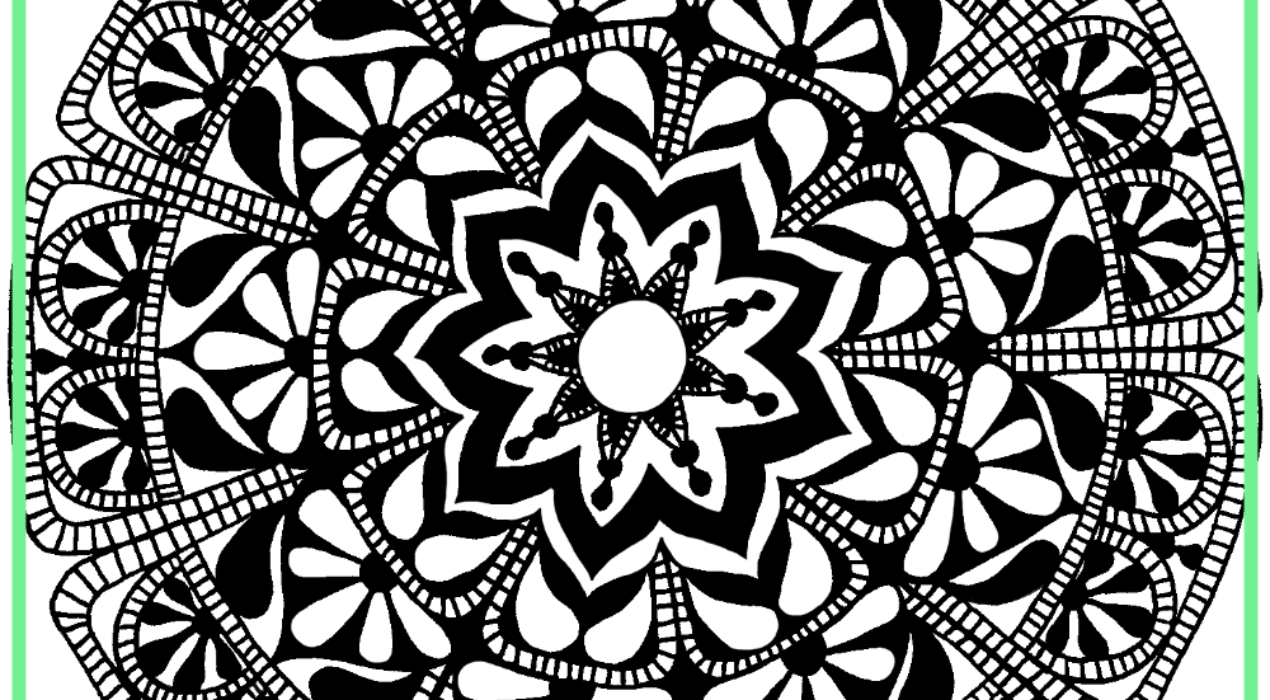
Mandala have been found all across cultures and thought out human history. We find them from East to West in so many different cultures: Dreamcatchers and Medicine Wheels of Native Americans, Aztec Calendars, Cathedral Rosettes in Europe, Buddhist Sand Mandalas… These patterns are more than just beautiful designs, they carry deep spiritual and cultural significance. What is a mandala for? Mandalas ask from you to be patient. Tibetan monks, for instance, spend hours creating their sand mandalas only to erase them once completed. This practice symbolizes that the process itself holds more value than the finished result. Just like in life, the journey is more important than the destination. But it also talks about impermanence, how nothing in this universe is “for ever”. Mandalas are also an invitation to meditation. You can look at the intricate designs and quiet your mind. It allows you to find some inner peace and to know yourself a bit more. Mandalas inspire a sense of beauty and with it, joy. Mandalas also act as links to the divine (Yantra), offering a channel to receive cosmic truths. They are protective symbols believed to ward off negative energies and safeguard the soul. At their core, mandalas […]
Read More ›